
Why milliseconds are important
Perception-reaction time is the name for the interval between a stimulus appearing and your response beginning. An enemy peeking round a corner, a starting gun, a brake light. From the inside, that interval feels instantaneous. It never is.
Road arithmetic makes the point fastest. A car at 100 km/h covers roughly 28 metres every second, so a driver with an ordinary 250 ms reaction time travels nearly 7 metres before their foot even starts toward the pedal. Nothing about the car matters inside that window. Only the driver's nervous system does.
Competitive gaming compresses the same arithmetic into a duel. On a basic click test, professional cybersportsmen averaged about 219 ms against roughly 271 ms for novices. In an evenly-aimed fight, a 50 ms advantage decides who fires first.
There is a quieter reason to care as well. Reaction speed peaks in the mid-twenties and then drifts slower by around 2-4 ms a year, so a tracked baseline doubles as an early-warning system for exhaustion, short sleep, and the gradual slide everyone would rather catch early. Run five rounds of the Classic Reaction Time Test before you read on, and the figures in this guide will actually apply to you.
What counts as a good score
Grades come from the median of five clicks, read off the same cited percentile curve used everywhere on this site. Under 200 ms is genuinely fast for a browser test, and under 150 ms is rare air: quicker than roughly 98% of visual test-takers.
Sound, touch and sight run on different clocks
Not every sense delivers to your muscles at the same speed. Sound and touch run short, quick paths to the brain, while sight pays a chemical toll at the retina before its signal has even left the eye. The averages below differ because of routing, not willpower.
| Stimulus | Typical average | Why it differs |
|---|---|---|
| Auditory (sound) | 140 – 170 ms | The cochlea turns sound into nerve signals almost instantly, and the path to the auditory cortex is short |
| Tactile (touch) | 150 – 180 ms | Skin mechanoreceptors fire through thick, fast, myelinated fibres |
| Visual (sight) | 200 – 250 ms | Before anything else can happen the retina must chemically convert light into electrical signals, which adds unavoidable delay |
Five steps, one reflex
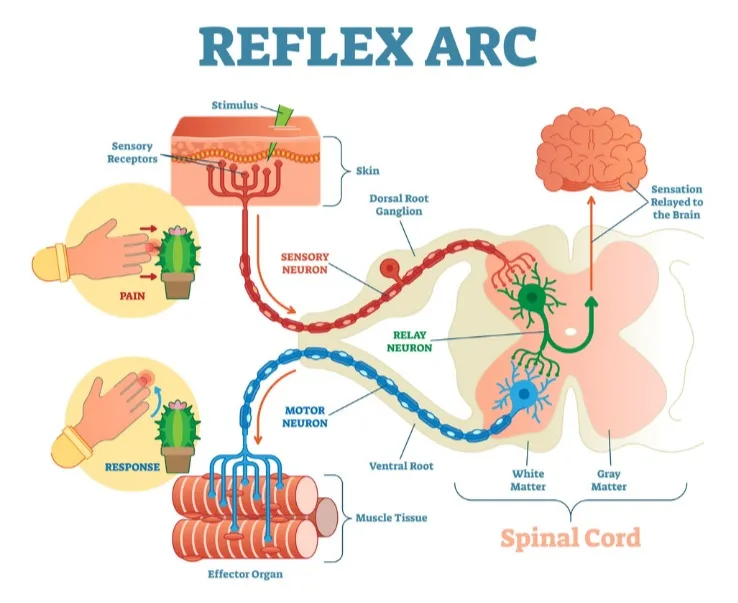
A reaction feels like one single event. What it really is: a five-leg relay, with every leg charging you time.
Photoreceptors in the retina or hair cells in the cochlea detect the change first. The sensory nerve carries that impulse to the brain, where the thalamus routes it to the visual or auditory cortex for the expensive business of identifying the signal and deciding how to respond. The motor cortex then sends the order down the spinal cord, and at the neuromuscular junction acetylcholine finally makes muscle fibres contract. Click.
Practice works because that middle decision step dominates the bill. Training does not speed up your wiring. It cuts the cost of recognising and committing.
| Stage | What happens | Rough cost |
|---|---|---|
| Receptor to brain | The retina converts light into a nerve signal and sends it up the optic nerve | ~20 ms |
| Central processing | The cortex recognises the signal and commits to a response | ~120 ms |
| Motor command | The order travels back down the spinal cord to the arm | ~60 ms |
| Muscle contraction | The neuromuscular junction fires and the finger actually moves | ~50 ms |
Simple, choice, and go/no-go
One light, one button is the simplest problem a nervous system ever has to solve. Add options and the price rises straight away.
Choice reactions, in which each of several signals calls for a different response, run tens of milliseconds behind simple ones. This is old and dependable psychology: response time scales with how much information the brain must resolve, a regularity known as Hick's law since 1952. The five-zone Choice Reaction Time Test on this site measures that exact surcharge against your own simple baseline.
Go/no-go tasks shift the difficulty from deciding to withholding. Your fastest press belongs to the go signal, while a no-go signal demands nothing at all and leaves the prefrontal cortex to strangle a response already on its way. Inhibition is a measurable skill in its own right, and the Go/No-Go Test scores your speed and your false alarms together.
Your eyes set the entry fee
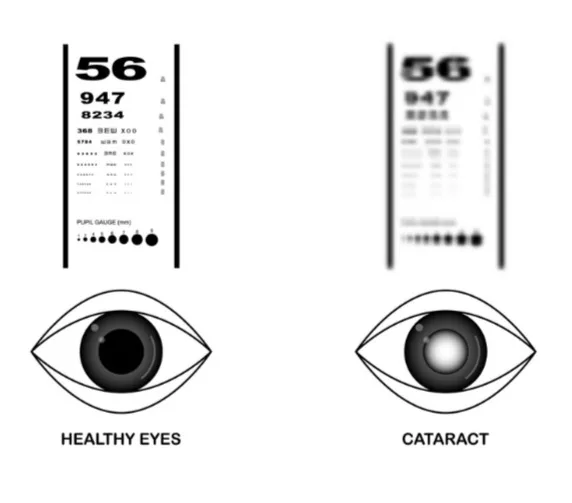
Most reactions life asks of you begin at the retina, and the retina charges admission. Converting photons into electrical signals is chemical work, and along with the trip up the optic nerve it costs roughly 20 ms before the brain sees anything whatsoever. Sound bypasses that chemistry, which accounts for most of why auditory reactions run faster.
Static acuity only gets you in the door. Dynamic visual acuity, the ability to resolve detail on a moving object, is what lets a driver read a merging car early or a batter read spin out of the pitcher's hand. Unlike prescription strength, it improves with deliberate tracking practice.
Peripheral vision follows different rules again. Detail resolution out there is poor, but motion detection is quick and feeds fast, primitive motor pathways. That is why you can start flinching at something you have yet to consciously identify. Experienced players lean on this by holding a soft, wide gaze rather than darting their eyes at every flicker.
Darting eyes cost genuine time too. Around every rapid eye jump, a saccade, the brain suppresses visual processing for tens of milliseconds so the world does not smear. Chain saccades together and you stitch small blind gaps into precisely the moments you needed to see. Fewer gaps come from a calmer gaze.
What training actually changes
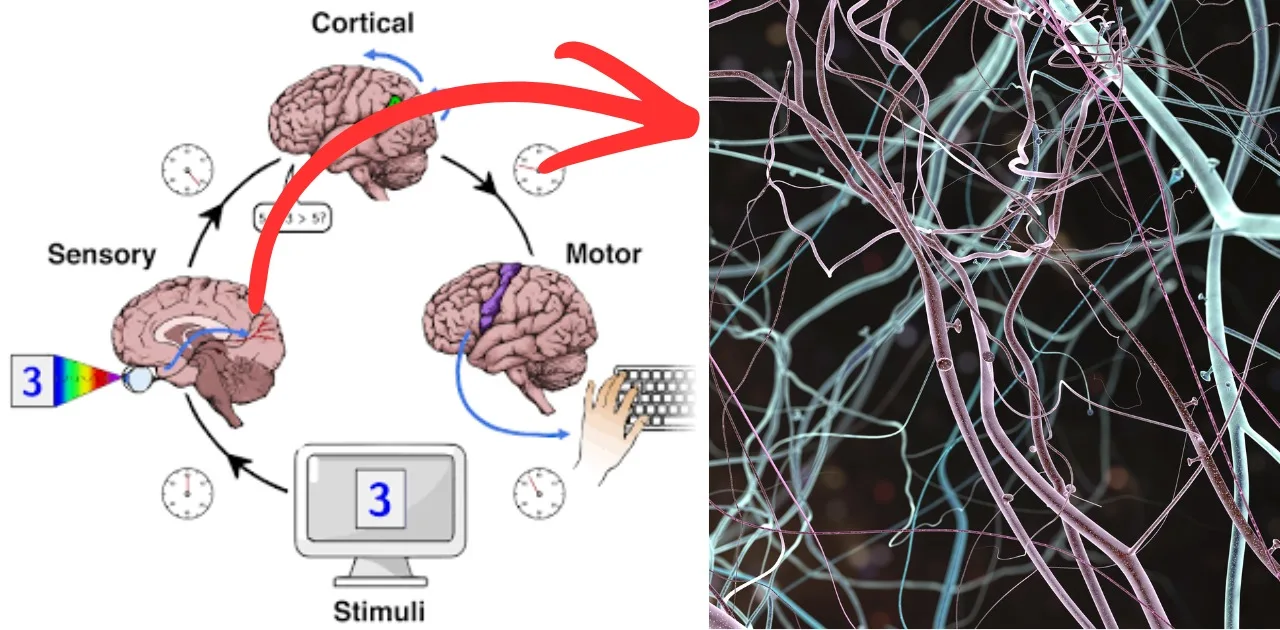
Repetition physically rebuilds the pathway a signal travels. Practice has the brain wrapping the nerve fibres involved in thicker myelin, the fatty insulation that upgrades a country lane to a motorway: unmyelinated fibres conduct at roughly 1 metre per second, whereas heavily myelinated ones reach something like 100 metres per second. Signals never find shortcuts. They find better-paved roads.
Action video games supply the clearest training evidence. Controlled studies showed action-game training sharpening the spatial resolution of vision itself, and a separate experiment found trained players reaching perceptual decisions measurably faster without sacrificing accuracy. The catch is specificity. Gains cluster tightly around whatever was trained, which is the lesson generic brain-training apps keep failing to escape: practise the thing itself, or the nearest drill you can find to it.
Age deserves the same honest framing. That 2–4 ms yearly drift after the mid-twenties is real, but it is a population average, not a personal sentence, and at any age the gap between a rested, practised person and a tired, distracted one dwarfs it. Defending that gap is where the margin lies.
Stillness is a speed technique
"He who conquers himself is strong," says the Tao Te Ching, and the Chinese martial traditions took the line at face value. Wushu and Tai Chi never treat speed as aggression. They treat it as a byproduct of ping jing (平静), an inner calm in which nothing sits pre-loaded and nothing must be un-decided before the right response can launch.
The standing practice of zhan zhuang trains precisely the state a reaction test rewards. Spend your processing budget predicting the stimulus and you are spending it on noise; a quiet mind leaves the entire channel open for the real signal. The tradition's other instruction, be like water, says the same thing from the other side: stay fluid, commit fully when the moment is genuine, and never rehearse an outcome so hard that you fire on the rehearsal.
One traditional proverb could have come straight from the inhibition research: a moment of patience prevents a great disaster, a moment of impatience ruins a whole life. Holding back until the right instant is a trainable skill, the same prefrontal control the Go/No-Go Test scores, and it is why any response under 80 ms is voided here instead of celebrated. A twitch that beats the stimulus is not speed. It is a guess wearing speed's clothing.
What moves the needle day to day
Your score is not a single number. It is a range, and where you land inside it on any given day is largely settled before you open the test at all.
Sleep is the heavyweight. A single shortened night slows reaction and attention tasks by around 29 ms on average, and 17–19 hours awake produces impairment comparable to sitting at the legal driving alcohol limit. Caffeine buys a little back, roughly 10–20 ms at moderate doses, with jitter and diminishing returns beyond that. The machine in front of you charges its own toll too: a 60 Hz screen may hold a finished frame for up to 16.6 ms before showing it to you, while a 240 Hz panel trims that wait to about 4.2 ms.
| Variable | Measured effect | Source |
|---|---|---|
| One night of short sleep | ~29 ms slower on reaction and attention tasks | Wüst et al. (2024) |
| 17–19 hours awake | Impairment comparable to the legal driving alcohol limit | Williamson & Feyer (2000) |
| Moderate caffeine | ~10–20 ms faster on simple reaction tasks | Rogers et al. (2024) |
| 60 Hz vs 240 Hz display | Up to 16.6 ms of frame wait vs about 4.2 ms | Refresh-rate arithmetic: 1000 ms ÷ Hz |
| Touchscreen vs wired mouse | Adds roughly 20–50 ms of input latency | Why this site never mixes desktop and mobile scores |
A four-week sharpening plan
Four weeks gives you enough time to find your real baseline, work the trainable parts, and prove the difference with numbers rather than vibes. Test rested, at the same time of day, and always after a couple of throwaway warm-up rounds.
| Week | Focus | The work |
|---|---|---|
| Week 1 | Baseline | Five rounds on the Classic Reaction Time Test daily, at the same hour each day. A rested week's median is your true starting number. |
| Week 2 | Eyes & tracking | Target work on the Aim Reaction Test, plus deliberate gaze habits: hold a wide soft focus and cut needless eye jumps. |
| Week 3 | Decisions & restraint | Alternate the Choice Reaction Time Test and the Go/No-Go Test. Speed that comes with false alarms is not speed. |
| Week 4 | Lifestyle & hardware | Fix sleep first, time your caffeine deliberately, check your screen's refresh rate, then re-test everything and set the medians against week one. |